Friday, May 09, 2008

University (non-)Relations

I would like to take this time to highlight the problems one student organization has been having with the Union Policy Board. This has extended into University Relations, as all of their records have apparently been transferred there.

Strategic Game Club has been denied an office in the latest office allocation, despite having filed all appropriate documents on time. In this, the latest round, the UPB held a meeting without notifying anyone who might be interested that it was taking place on May 7. The legality of such a move has yet to be determined, but the important part of that meeting, as far as this discussion is concerned, is that the club was removed from a previous allocation because of, among other things, "current and previous/continued lease-violations".

The idea of "current and previous/continued lease-violations" was news to the club, and London Burt, the Secretary, made a request for previous UPB meetings and any records of lease violations, so as to understand what things were being used against them. Here is the reply he received:
From: Amy R. Watson <awatson@uwm.edu>
Date: Thu, May 8, 2008 at 5:42 PM
Subject: Re: Open Records Request
To: London Burt <malkavian999@gmail.com>


Hi London,

First, this message serves as receipt of your request for an audio copy of the meeting held on May 7th. I do not know if I am able to provide that to you in the next day or two, but I will certainly process your request as quickly as I can.

Second, I am still working on your first request, which I hope to complete soon. One clarification: you did ask for complaints, allegations, or investigations about lease violations about Strategic Gaming Club, but you did not provide the time frame of five years, so I will have to find out if there are any such documents that date back to 2003.

Also, one note. The reason this request takes some time is that in accordance with FERPA (the Family Educational Rights and Privacy Act), I cannot release the personally identifiable information of students in conjunction with their activities in an organization. This means that the audio you are requesting as well as the copies of the UPB minutes will be heavily redacted, because personally identifiable information extends beyond just name. It includes other information that would make a student's identity easily traceable, and that includes a student's voice. So, the only portions of an audio recording of a UPB meeting that I can release are the voices of non-student employees who are members of the UPB or at a UPB meeting (for instance, Scott Gore or Tom Viel).
When I complete the request and provide the documents to you, I will provide a more detailed explanation as well as citation to the FERPA federal statute and regulations. I just want you to be prepared that the minutes and audio recording will have significant redactions.

Thanks, and I will be in touch as soon as I can.

Amy
--

Amy Watson
Communications Project Manager/
Public Records Custodian
Department of University Relations
UW-Milwaukee
(414) 229-5188
(414) 229-6261 fax
I understand that privacy issues regarding student organizations are to be respected. I would not want the records of random organizations thrown into the public record. However, the organization being considered here is the Union Policy Board, and the material being considered here is the audio record of the meetings at which they make policy for the UWM Union. A such, this is more of a government organization, as they have the power to vote on the Union budget and assign office space within the Union; and their membership, meetings, and activities are open to the public. Being willing only to publish non-students' comments (which make up 1/3 of the voting membership and 40% of overall membership) frustrates the idea of open meetings, especially since this is the committee in charge of a large portion of non-allocable student segregated fees. This unholy alliance of secrecy on the part of the University Relations department and the Union Policy Board in charge of large amounts of money (and half a floor of office space) is an open invitation to corruption.

Sunday, February 10, 2008

SA Sedition Act?

From the preprinted agenda for tonight's meeting:

SA Sedition Act
Author: Senator Ohler
Sponsors: Senator Ohler, Senator Piwarun, Senator Draheim, Senator Kristopeit

Whereas the Student Association at UW-Milwaukee is a venerated institution critical to preserving and expanding student rights, and

Whereas in the recent past some parties have disseminated untrue or otherwise misleading statements about the Student Association, and


Whereas libel and slander are not protected free speech, therefore

Be it resolved that upon evidence of libel or slander communicated by one or more individuals, or by one or more groups, the Student Association shall issue a cease-and-desist order to such entities, and

Be it further resolved that if the aforementioned entities do not cease libelous or slanderous communications regarding the SA after being served, the SA shall pursue civil relief against said parties, and

Be it finally resolved that the SA shall allocate from its reserves for this purpose if and only if no other funding mechanism is available.


I have been asked to comment on this proposed legislation. Here are my thoughts:
1. If the SA is really being libeled or slandered, the Senate has every right to fight against it.

2. However, my past dealings with the SA Senate lead me to believe that the actions the Senators term "libel" or "slander" is probably just dissent, and dissent is a natural part of the democratic process.

3. Therefore, while I support the concept of the bill, I will be very suspicious of any letters sent under its auspices, and extremely suspicious of any civil suit filed.

4. I will be even more suspicious if any such letters are sent my way.


This situation will be monitored here.

Thursday, August 30, 2007

No one claims responsibility for Union Policy Board

Last year, the University Student Court denied that it had jurisdiction over decisions made by the Union Policy Board. This year, it's the Administration. Here is the redacted text of a letter sent by the Vice Chancellor for Student Affairs, Helen Mamarchev:

August 14, 2007

Dear [student organization representative]:

Following an extensive review of the Union Policy Board Constitution, I have determined that student organizations' rights to appeal are limited to the Union Policy Board, not the Director of the Student Union or the Vice Chancellor for Student Affairs.

Therefore, any request for appeal by [your organization] must be submitted to the Union Policy Board for their consideration.

Sincerely,
Helen L. Mamarchev, Ph.D.
Vice Chancellor for Student Affairs


This places the Union Policy Board in the unique position of being its own oversight board. So if a decision is clearly wrong, you just appeal it -- to the Union Policy Board. And if they refuse to hear it, appeal that decision -- to the Union Policy Board. This is obviously an exercise in futility.

The Union Policy Board Constitution states that the Union Director may appeal policies within ten days, and he may choose to send this appeal to the Vice Chancellor for Student Affairs, but Dr. Mamarchev's interpretation of this is that student organizations may not ask for such an appeal, not even from the Union Director. This means that, if the Union Director is somehow unable to attend a Union Policy Board meeting at which a problematic policy is passed, and the record of the meeting does not allow him adequate time to file an appeal within ten days, a student organization representative can't inform him of the problem. Instead, this must be filed with the Union Policy Board itself, which meets every month -- far too late for any appeal.

Action needs to be taken now for there to be a legitimate oversight mechanism for the Union Policy Board.

Friday, May 11, 2007

Needless panic over stupidity on Facebook

DISCLAIMER: I do not condone violence against any student, student government official, or member of the campus community at UWM. Any attempt to read the remarks below as encouraging any of the above actions is a misreading, and should immediately be abandoned. If you do not see how to avoid such a reading, please contact me before making any public statements so I can help you understand my intentions more clearly.

The Student Association again made news this week when an alumnus made comments on Facebook suggesting that their problems could be solved by gathering them into a room, locking the door, and gunning them all down. The reaction by SA officials is to demand that this person, who now lives in another state, be charged with a crime for making these remarks. While the comment is stupid, the facts of the case indicate that anyone who has any sort of knowledge of the workings of SA could immediately see that this was harmless, and anyone who has such knowledge but chooses to take the threat seriously is just causing needless panic.

Take the substance of the threat. The poster suggested that the solution to SA's problems would be to call a general meeting of SA in Bolton 150, lock the doors, then take his machine gun (which he conveniently provided a picture of, with him holding it) and open fire. This sounds scary, as he seems to provide all the details as to how to pull this off. However, the chances of this scenario coming to pass are about as likely as watching Jupiter eclipse the sun.

To begin with, the poster makes no distinction among the various officials of SA: senators, justices, and the members of the Executive branch are all apparently treated equally. The rules for calling each branch into session are far different, and no single act has brought all of them together into one place in quite some time. Even if it were to happen, it would not be possible for a single student to call a general meeting of all of them, much less an alum. Emergency senate meetings, which this would have to be, require either the President or five senators, and can only be called for specific purposes.

As for the named room, Bolton 150 is a large lecture hall that is totally unsuitable for senate meetings. The standard setup for a senate meeting is to have a front table with the Speaker and other officials, the senators seated at long tables, and then seating for observers set behind the senators, so that a clear space exists between the senate and the crowd. Bolton 150, while large, does not have the capacity to conform to this. Therefore; since the Student Association would be the ones making the request for a room, they would not choose Bolton 150.

In addition, Bolton 150 is considered a classroom, unlike the normal meeting areas of the SA. Most events done by Student Association are done in the Union, and reservations for these rooms are handled by the Union Reservation and Event Planning Service (REPS). Classrooms, on the other hand, are done through a different agency, and the only time such a room would be used is if no other suitable room were available in the Union, as that process is much longer.

Also, the situation of who would be in a position to lock a door is different. Building custodians and UWM Police officers are the ones who hold keys to classrooms, while the Union's Client Services and REPS people hold keys to the Union rooms. Thus, the chances of finding the keys to lock the door are greatly reduced by doing the "hit" outside the Union. And even this problem is overcome, the fire codes mandate that the doors be openable from the inside even when locked.

Now for the problem of bringing enough firepower onto campus to execute the threat. There are people on this campus who are paranoid even about foam weaponry as used by live action roleplayers and wooden "swords" used for kendo classes. If any of these people saw a real weapon on campus, especially around the time of an historic "general meeting of SA", they would melt the phone lines of the UWM police, the Milwaukee Police, and any other officials they could reach trying to get people onto campus to stop the perpetrator.

To summarize, the "plan" to assassinate SA officials relies on people calling meetings they can't call; into a room that the people who are supposedly going to meet wouldn't use over several more eligible ones; finding one of the few sets of keys that exists to that room and using it to lock doors set up to allow people to exit despite being locked; and managing to bring a large machine gun past a campus that already is paranoid about weapons. As such, anyone who heard about it in all its "detail" should have recognized it for the joke that it is. The administration seems to understand this, as all they have demanded of this person is a public apology. For everyone else, may I point out that a threat that can't be carried out isn't really a threat?

Union Policy Board Meeting of May 7 to be redone

The Union Polilcy Board met on May 7 to finalize the office allocation map, or at least that was the intent. After some discussions about possible moves, a motion was made by SA President-elect Robert Grover to make no changes to the map. This motion was supported by three members (Grover, Stueber, Nelson) and opposed by three members (Scott, Givens, Dercks). The UPB chair then voted to break the tie and approve the map as final.

There are, however, two major problems with this maneuver. One has to do with the map itself. If you take a look at the map, which is found in front of the Student Activities office and in the Student Organization wing near the mailboxes (and has a revision date of 4/30/07), you will see that the UWM Post (currently in EG80) has no listing, not even in the "Not on Map" section, and that their current location is listed as being assigned to Student Association. Furthermore, the SA's current location (EG79) and the Studio Arts and Crafts Center (currently EG77) are both listed as empty.

But there is also a parliamentary problem with this maneuver as well. I reported that there were three votes in favor and three against, with the chair breaking the tie. However, the chair of the UPB is Robert Stueber, who had already voted on the matter. Robert's Rules of Order, the parliamentary authority of the UPB, explicitly forbids a chair from both voting as a member of the board, then again as the presiding officer. This matter has been forwarded to Scott Gore, the Union Director, who is using his authority per the UPB constitution to bring it back before the board.

Wednesday, March 28, 2007

Helping the Union Policy Board do its job...

With the Union Policy Board scheduled to take its last kick at the office allocation can in just two weeks (April 11, 3:30 p.m. to be exact), I would like to take this opportunity to encourage the members to become knowledgeable in the process. To that end, here are some questions that members should familiarize themselves with. In addition, being able to cite written, verifiable sources of the policies involved is a very good thing.

1. Which documents provide relevant information on the office allocation process?

2. What are the criteria under which the UPB may assign office space?

3. Does filing an application for office space guarantee that one will be allocated to the applying organization?

3a. If so, what should an organization who knows that an applying organization is ineligible for an office do?

3b. If not, under which conditions would an organization not receive an office, and what procedures are in place for checking for these conditions?


4. If the UPB is unsure of the capacity or usage of an office, what options do the members have to gain this information?

5. If, after this meeting, an organization believes there are procedural errors which unduly damaged the members, what is that organization's next productive course of action?


I know of at least two members of the UPB who read this. I would ask any members who do read this to forward these questions to those who do not.

When I can get to it: The election madness

Monday, January 29, 2007

Senate runs late into night to complete funding requests

In a meeting that lasted nearly six hours, the SA Senate approved funding for all of the entities that were recommended for funding by the Senate Finance Committee, plus added funding back into the budget for four entities that were declared ineligible by SFC: Women's Resource Center (WRC); Lesbian, Gay, Bisexual and Transgender Center (LGBT), Peer Outreach and Mentoring (i.e. the LINKS center) and the Center for Volunteerism and Student Leadership (CVSL). However, the means by which this was done is a parliamentary nightmare that I, for one, don't feel comfortable about. I will go into the funding votes, from the beginning, and discuss all the decisions made. Those of you who fancy yourself to be experts on parliamentary procedure may wish to inject commentary as to how legal this is, and what the ramifications of the process as done are.

After attending to the necessary business of hearing reports and electing replacement senators to fill vacancies, the next item in Special Orders was the SFC funding requests. Most of the groups who applied were recommended for some level of funding. One group, Campus Activities Board, was approved for a token amount of 5 cents per student (or about $1400 total). This recommendation was made because the SFC did not think they were doing anything useful, but since they are a standing committee of SA, they must be funded at some level. Campus Activities Board is the organization that sponsors the Homecoming events at UWM, and has sponsored several other events in the past.

Six other organizations were declared ineligible for SFC funding: These are the organizations, together with a summary of the reasons they were declared ineligible:
Panther Dance Team -- neither a sub-unit of SA nor a critical service as defined in the SFC Bylaws section VII.D
Union Activities Board (8th Note) -- neither a sub-unit of SA nor a critical resource
Peer Outreach and Mentoring (LINKS) -- not a sub-unit of SA, and provides duplicated service already covered by the Peer Mentoring Center in Bolton Hall
Center for Volunteerism and Student Leadership -- not a sub-unit of SA and provides a duplicate service, since SA also provides opportunities for volunteerism and student leadership
Women's Resource Center -- not a sub-unit of SA, provides a duplicate service since SA has a Women's Issues Coordinator. Also, while it is an on-campus resource center not currently funded by SAC, it does not meet the requirements of Section VII.D8, because it does not serve the needs of all UWM students.
LGBT Resource Center -- not a sub-unit of SA, provides a duplicate service since SA has an LGBTQ Issues Coordinator. Also, while it is an on-campus resource center not currently funded by SAC, it does not meet the requirements of Section VII.D8, because it does not serve the needs of all UWM students.


With the exception of the SA Legislative and Executive allocations, two stipulations were put onto every group for which the SFC recommended funding:
I. SA Logo Stipulation: All official advertising/materials of the organization/deparment must prominently display the official SA Logo. The SA Senate will determine when a violation of this stipulation has occurred. A first time violation within any 12 month period will carry a fine of up to $10000, as determined by the SA Senate. Second and subsequent violations of this stipulation within any 12 month period will carry a fine of $10000.
II. Oversight Stipulation: Not including SFC suggestions, significant alterations to proposed budgets or negative alterations to services provided must be approved in advance by the SA Senate. The SA Senate will determine when a violation of this stipulation has occurred. A first time violation within any 12 monthe period will carry a fine of no more than $50000, as determined by the SA Senate. Second and subsequent violations of this stipulation within any 12 month period will carry a fine of no less than $10000 and no more than $50000, as determined by the SA Senate.


Two other groups received additional stipulations:
UWM Athletics: Funding level unconditionally set at $74.00, and to approve $77.75, contingent based on acquiring an additional $250,000.00 annually from the University, and it can not be from Segregated Fees.

Student Activities Office: Amount of funding would not go toward an assistant director.

When the funding requests came up, a question was put to the floor as to whether the groups that were denied funding could even be brought up by the Senate. From the SFC Bylaws:
XV. Senate Approval
A. The Senate may approve, deny or change a recommendation to fund or deny funding to an applicant.
B. The Senate may not fund an applicant whose request for funding was not considered by SFC regardless of the reason for non-consideration.


The argument (presented primarily by Senator Dan Bahr) was that since the organizations were declared ineligible, they were not considered by SFC for funding, and therefore could not be added back in by the Senate. After submitting the matter to the Student Court justice kept on hand to act as Parliamentarian, the ruling was that the determination of ineligibility was effectively a recommendation by SFC to deny funding, which could be changed by the Senate in accordance with Part A. Part B was put in place to prevent an organization from bypassing the SFC process by waiting to submit until after SFC had finished their recommendations, not to give the SFC absolute power to deny a group without Senate oversight.

With that ruling dealt with, the first motion on the floor was to approve the recommendation as presented by SFC. As this requires a 2/3 vote, it failed. Then a motion was made to split off the decision on the six groups denied funding plus UPARK. That motion passed by a majority vote (it did not approve or deny funding). The next motion was to approve the recommendations by the SFC for all other groups, which passed by the necessary 2/3.

After this, a motion was made put the four student resource centers (LINKS, WRC, LGBT and CVSL) into a package and approve them en masse. Heated debate ensued, but this motion failed by one vote.

The next motion was to approve the LGBT center for eligibility. After more heated debate, this passed 21-7.

The next motion, which would approve WRC, had another strange quirk in it. Senator Antwan Jones was not in the room when the roll was called, but he entered as the vote was being counted. When he asked for the right to vote on the matter, he was denied, being told that the votes had been counted (even though they had not yet been announced). Despite that, the motion failed failed 18-10, another close call. As it turned out, his vote would have made it 19-10, which still would have failed.

At this point, a motion was made to adjust the SAC funding, as now it looked like SAC would need extra funding to cover the lost resource centers. After more rancor, the motion was tabled until afterward to see just how much extra funding would be needed.

At this point, it was getting to be 10:40 p.m., and the ballroom was only reserved until 11:00. (A word of advice to whoever reserves rooms for SA: If you are going to reserve the room until 11:00, go all the way and reserve it until midnight, as no one will reserve a room for that hour anyway. True, no one's going to kick you out of that room in the meantime, but at least you don't have the mad panic at 10:40 wondering what to do.) So a motion was made to recess the meeting until another time to be determined by Speaker Voigtlander, so that they didn't automatically reject all unconsidered organizations. Since no one was sure if they could make the meeting time and they couldn't agree on one on the spot, the vote to recess failed 14-16. Thus the meeting continued.

Debate times were constantly being shortened to get things done. So here are the remaining votes in rapid succession:
Package WRC and LINKS and approve them for eligibility: Passed 21-10
Deny eligibility to UAB & Panther Dance: Passed 21-9
Approve UPARK at $9.00, up from the $8.50 recommendation: Passed 25-4
Approve Eligibility for CVSL: Passed 24-5
Approve the four newly eligible organizations at 2006-2007 levels: Delayed to consider amendment
Amendment to stipulate that the funds only be used for student employees: Failed 4-26
Approval of 2006-2007 funding levels: Passed 21-6

Also, in a (literal) last minute action the Concurrent Services Act was passed. This defines the Presidential Cabinet in the Student Senate Bylaws as the President, Vice President, Chief of Staff, Treasurer, Academic Affairs Director, Legislative Affairs Director, and Shared Governance Director.

A complete list of funded groups, their per student funding levels, and an approximate total funding level, will appear later.

Wednesday, January 24, 2007

Why is it closed? And why was it ever open?

The Student Organization Programming Center (SOPC) has been closed since the start of the semester. While I was never a big fan of it, there has been no explanation as to why this place was closed.

My cynical side wants to assert the utter uselessness of the SOPC as a reason for closing it. But there are so many other things that operate at this university without any concern for such trivialities as usefulness, so that's not a viable explanation.

I have heard a rumor that it is related to the general defunding of programming centers by the Senate Finance Committee. Links, CVSL, Women's Resource Center and the LGBT Center were apparently told they were not eligible for student funding because they don't service the entire student population. I don't think they are related, but I do want to comment on the defunding.

The reasoning for defunding them came from the newly passed Senate Finance Committee Bylaws:

VII. Criteria for Funding Eligibility
C. The applicant must:
1. Provide a critical resource, as its primary mission, not offered by other campus entities.

D. "Critical Services" consist of:
1. Student Health Facility
2. Transportation services for students
3. Professional legal services for students
4. Student housing assistance
5. Direct administrative support for student organizations
6. Child care services for students
7. UWM Athletics Department
8. On-campus student resource center, not currently funded by SAC, whose primary mission is to serve the diverse needs of all UWM students


That last part is the key. The argument is that these centers don't serve all UWM students, but rather a limited subsection of students, and therefore don't qualify for funding. But each of these were created to enhance the services for an underrepresented group, and the sum total of their efforts do serve the diverse needs of all UWM students. This seems a bit shortsighted on the part of the SFC.

The actions of the SFC must be approved by the student senate and SA President before they take effect. But as of now, this is a rather dramatic departure from previous policy and it deserves to be looked at.

Wednesday, December 06, 2006

So now they want to play by the rules -- sort of

The Student Association Senate has scheduled another meeting to replace the one they couldn't hold due to lack of quorum. Here is the relevant text of the notice:

PUBLIC NOTICE
The Student Association of the University of Wisconsin - Milwaukee
EMERGENCY STUDENT SENATE MEETING
DATE: Sunday, December 10th, 2006
TIME: 6:00pm
LOCATION:
UWM Union Ballroom
2200 E. Kenwood Blvd.
Milwaukee, WI 53211

Agenda First Available on Friday, December 8th, 2006
By emailing: amandav3@uwm.edu
All meetings are open to the general public.
The senate may go into closed session pursuant to Wisconsin State Statute 19.85(1-6)
According to SA Senate Bylaws Article II Section VI, an
Emergency meeting must be held when requested by 5 senators.
"Emergency meetings shall be for the sole purpose of approving SFC or SAC actions..."

In another world, we could just accept this as is and move on. But in the world we have seen so far, it makes sense to post the section of the Senate Bylaws relevant to this situation, namely Article II, Section VI:
Article II -- Meetings
Section 6 -- Emergency Senate Meetings (for those of you following with your own copy of the Senate Bylaws, it's the second Section 6 -- i.e. the one after the Section 6 dealing with the State of the Students Address)
a. Emergency Senate meetings shall be called by the Speaker of the Senate or by the request of 5 senators, in writing, to the Speaker.

b. The agenda shall be written by the Executive Committee.

c. No senator shall be penalized for absences during emergency meetings.

d. There must be at least 48 hours between the time the meeting is called and the meeting itself.

e. Quorum shall consist of 40% of Senate Seats filled.

f. Emergency Senate meetings shall be for the sole purpose of approving SFC or SAC actions or taking up items requiring Senate action due to timelines outside the control of the Student Association.

So, when the meeting in the garage was to be held, it was for "items requiring Senate action due to timelines outside the control of the Student Association" clause that doesn't appear on the notice. Yet, here, the implication of the notice as written is that this clause doesn't exist.

If you want to be around when the Executive Committee creates this agenda, that will be on December 7 (i.e. tomorrow as I write this) at 3:30 p.m. in EG79I, 16 minutes after the Shared Governance meeting. Either there are so few items being covered by Shared Governance that their meeting will be extremely short, or the Executive Committee will have to set the agenda without the input of the Shared Governance Director.

But the big question is this: Why should all the other items wait until the next regular meeting? The only reason they weren't discussed was there was a lack of quorum, and the number who did show up (12) isn't enough for quorum even for an Emergency meeting (16).

As for timeline issues, the Election Commission Formation Act becomes nearly meaningless if not passed now. The Concurrent Service Act can possibly wait, but why should it? The Student Association Senator Award Act could run into problems if its failure to be addressed removes a senator who would have been eligible to remain had it passed. There are constituencies who would argue that these and other measures need to be addressed sooner if not later. Why create a notice that precludes them?

Monday, December 04, 2006

No Quorum, what now?

In the fine tradition of the Student Association Senate, the meeting scheduled for December 3 could not be held due to lack of quorum. Normally, this doesn't happen until near the end of the school year, when one controversy or another keeps a large block of senators away, but this time it's happening in December.

Here is the agenda listed for that meeting; what could have kept them away this time? Could it have been the proposal that would finally resolve the separation of powers? The Concurrent Service Act would amend the Senate Bylaws, Article VII, Section 1(f) to read: "Senators may not concurrently serve as a member of the Presidential Cabinet or as a Student Court Justice. The Presidential Cabinet shall be defined to include the following positions: President, Vice President, Chief of Staff, Treasurer, Academic Affairs Director, Shared Governance Director, and Legislative Affairs Director. The Vice President will retain his right to cast the tie-breaking vote in the senate as defined in Article V Section 6(a) of the SA Constitution." This would keep some people out of concurrent service, but there are some notable exceptions, such as the Secretary and the other Directors not specifically named above. But there is another problem that the legislation as written does not address. What happens if a shady SA President decides to have the same types of offices but call them different names?

Maybe the item that kept senators away was the Nursing Mothers Protection Act. This would guarantee the rights of women who choose to breastfeed their children to do so anywhere where the woman and her child are otherwise allowed to be. This came about as a result of the previous senate meeting, where a provision to ask the Union Policy Board to change one of their policies was justified by "inappropriate breastfeeding" in a Union office, among other things.

Could it have been the Students Vote Act of 2006? That would have directed the Vice President or designee to work with the City of Milwaukee Election Commission to adopting a campus polling place in the next election cycle to be staffed primarily by student volunteers and to investigate the lack of ballots during the last election. That doesn't seem too controversial, so I wouldn't expect that to be the problem.

Also on the agenda, we had the Election Commission Formation Act of 2006. This would require the formation of an Independent Election Commission by the start of spring 2006, "appointed by a special election committee, consisting of two persons from each party or independent candidate in the last election and/or representing student organizations on campus", not to include current or former members of SA government or any former IEC member. It would also change the name to Independent Student Association Process Committee and require that the Dean of Students or another administrative representative be present for all vote counting. Given the general reluctance to appoint an Independent Elections Commissioner, that may be what kept people away, but we'll see.

Then there is the last issue on the listed agenda (i.e. the one sent out by e-mail), the Student Association Senator Award Act. This would change one rule in the Senate Bylaws [Article IV, Section 1(d)] and remove 4 demerit points for being "present and not late or leaving early at a Senate meeting" instead of the -1 listed. Note that this rule is in the Senate Bylaws, so it would need to be passed as a Bylaws change and thus take a 2/3 vote.

Even so, this would cheapen the system as it stands. First, you need 12 demerit points (or miss three consecutive Senate meetings) to be removed from office. Second, if you inform people ahead of time of your absence, you only accumulate two per meeting, not four. Third, you only get to remove demerits if you have accumulated them in the first place. So this measure, if passed, would allow a person to miss two meetings with notification, then attend one all the way through and have the exact same demerit record as someone with perfect attendance. This is ludicrous.

Apparently the meeting will be rescheduled for December 10, same Bat-Time, same Bat-Channel. Let's just hope it isn't the same Bat-Result.

Saturday, December 02, 2006

Wondering about Senate Agenda

At the last Constituent Services Forum, it was indicated that there would be a streamlined process for getting the agenda for upcoming Senate meetings. As of now, this has yet to be implemented.

Tuesday, November 28, 2006

It's back...

I wish to thank the good people in the Legislative Affairs department for getting the SA Constitution back online. In an era of distrust and suspicion, it's good to see something being done correctly.

On another note, someone pointed out that another missing face appeared here.

Thursday, November 23, 2006

Coming off the milk carton

SA Thanksgiving Photo


This was found in a Facebook folder of an event with all of the top SA officials. Happy Thanksgiving!

Tuesday, November 21, 2006

Restructuring the Division of Student Affairs?

I have come across a draft of a letter intended to be sent to Provost Rita Cheng, among others by Student Association President Samantha Prahl:
November 20, 2006

Dear Provost Cheng,

It has been brought to my attention, via a forwarded email, that the University has established plans to restructure the Division of Student Affairs. The students were never made aware of such endeavors. "As active participants, there must be a meaningful opportunity for input so that student ideas are received and considered before decisions have been made and the meaningful opportunity must include timely notice to students of pending issues concerning immediate governance and policy development of the institutions." Regent Policy 86-4.

It is the position of the students that the University of Wisconsin - Milwaukee Administration is in violation of both the letter and the spirit of Wisconsin Statute 36.09 in regards to the restructuring of the Division of Student Affairs and we request immediate relief from the Office of the Chancellor under Regent Policy 86-4. It is our belief that the Chancellor has vested you, as Provost, with the responsibility to review this matter per [Wisconsin Statue] 36.09(3)(b).

The fundamental thrust of 36.09(5) is to ensure that students are "viable participants in university affairs." Regent Policy 86-4. The most minimal standards of compliance under 36.09(5) and Regent Policy 86-4 have not been met. An elementary reading of the Statutes and Regent Policy affirms this position.

I look forward to working with you to remedy this most troubling situation. Wi will await your reply.

Sincerely,

Samantha R. Prahl
President
UWM Student Association

CC: Chancellor Santiago
Interim Vice Chancellor Hill
Student Association Senate


As this is a draft copy, I have no idea how the final presentation will be laid out. However, I do support the effort being made.

The pull quotes from Regent Policy 86-4 are accurate. The text can be found here, although it begins at Page 85 of that document. This is also the place where it states that any irreconcilable difference in the interpretation of 36.09(5) may be taken to the Board of Regents through the UW-System President.

The reference to Provost Cheng being in charge of this is based on Wisconsin Statute 36.09(3)(b):
The chancellor may designate a person as provost, to act as chief executive officer of the institution in the chancellor's absence, if the person currently holds a limited appointment as vice chancellor, associate chancellor, assistant chancellor, associate vice chancellor or assistant vice chancellor. The chancellor may not create an additional administrative position for the purpose of this paragraph.

As the Chancellor is recovering from surgery at the moment, this qualifies as an absence during which the Provost acts as chief executive officer.

This news is troubling at this time because the University is currently reviewing candidates for Assistant Chancellor for Student Affairs. If this restructuring takes place, it will have been done prior to the new Assistant Chancellor's selection. Also, unless action is taken immediately, it will have been done without the meaningful opportunity for students to have input on this matter.

Saturday, November 18, 2006

What are you guarding?

I am taking a bit of a leave from my standard fare to explore part of the philosophy of Well Armed Sheep and my take on it. It deals with what I consider the role of this weblog to be. I will begin, though, with a few hypothetical situations.

Suppose you are trying desperately to get one of the new video game systems out there (you know, whatever the hot new thing is out there that they only make about 100,000 of even though about 100 times as many people will want it as soon as it comes out and you get people willing to pay 5-10 times retail for it on Ebay). You have a friend who works in a store that's selling them. Do you ask your friend to hold one for you? If the friend offers to hold one for you, do you accept? What if the friend asks for money to hold it for you?

You are trying to get a law passed. Everything is written, passed, goes through the proper channels and spurs a lively debate on the floor, but it is destined to fail for lack of support. Does this bolster your confidence in the government or undermine it? What if a key opponent offers to let it through in exchange for something else?

I could bring up more of these, but the point I am trying to make here is one of choices that we all must make from time to time. I see many decisions as being made based on one is a guardian of results or of process. I believe that there are times when being a guardian of results is the best course of action, whereas other times being a guardian of process is correct, but the overall balance for me weighs in favor of process. And that is what this weblog is geared toward: guarding the process of student government from abuse by those who are too focused on results.

A person who acts as mostly a guardian of results often appears to me to be one who lacks conviction and principles. I see it as a willingness to change the rules to suit one's own desires at the time. When a group gains power by challenging the corruption of others but tolerates the same or worse among its own members, I see them as guarding results over process, and that frightens me.

This means that, in most cases, I believe a good process is better than a favorable result. If the process is upheld but the particular decision goes against me, so be it. Now there are times when the process itself is bad, and as such, bypassing it may be for the best for everyone. I don't have a problem with that, so long as this becomes a catalyst for fixing the process. Without that balance, the possibility of abuse and favoritism is too great, and everything falls apart.

With that in mind, let me make it clear that I don't believe that student government should be abolished. Rather, the processes that are being abused need to be fixed, and those who are abusing them need to be taken to task for them. I don't mind rules that create restrictions, as long as they apply to everyone; for if the rules prove too abusive, the fact that they are universally applied will cause them to become unpopular and thus worthy of change.

I am starting to hear more people who agree with this concept. Welcome aboard!

Friday, November 17, 2006

Conspiracy theorists...

I received the following as a comment about a previous note:
For your information, the SA website was hacked and deleted last week, probably by someone friendly with you or one of the anti-SA Facebook groups. There was a backup of many of the files, but not of the Constitution, among others. Please cease your conspiracy theorism.


Fascinating. Since my comment about it was so brief, here's a full reprint of what I had to say about the missing Constitution:
Wednesday, November 15, 2006
SA Constitution missing from website.

This may not mean anything, but the link that normally connects you from the SA website to the online version of the SA Constitution is not working right now. For those who wish to try it: http://www.uwm.edu/StudentOrg/sa/Constitution.htm

We'll see what comes of it


To be honest, I don't see how that is expounding on a conspiracy theory. I am simply pointing out that an online tool that I use frequently is no longer available. If anyone wishes to explain what this means (I would ask the person directly but he or she has chosen to reply anonymously), please do so.

I would, however, like to address the comment directly. Beginning at the beginning, "For your information, the SA website was hacked and deleted last week, probably by someone friendly with you or one of the anti-SA Facebook groups." I'm not sure when this deletion occurred, as I don't usually monitor the SA website except when writing for an article or explaining the information to others when I happen to be near a computer. But nevertheless, it would be a simple enough matter to replace, would it not? There clearly is a previous version available that could be modified to reflect changes. If modifying a PDF is too much, it is also found as a Word document through simple searches. If all these failed, it would be a reasonable use of office time and office staff to get someone to take an electronic copy of the current Constitution (which must exist somewhere within SA) and link it into the site, or at the very least get a paper copy from somewhere (even the administration if necessary) and have someone type it in. So the idea that this information has been missing from the site for at least 36 hours shows some degree of either indifference or incompetence.

But as someone who uses the information posted on the SA websites, why would I want to see it removed? The people I have met who are fighting against SA are seeking more transparency and information from SA, not less. Such a move is detrimental to the process. Is our anonymous poster trying to say that I believe that the information is being removed specifically to prevent people like me from using it against SA? Let's just say that if that were true, there would be a lot more missing than just the Constitution.

Wednesday, November 15, 2006

Rueden in Senate Appropriations?

Senate Appropriations Summary
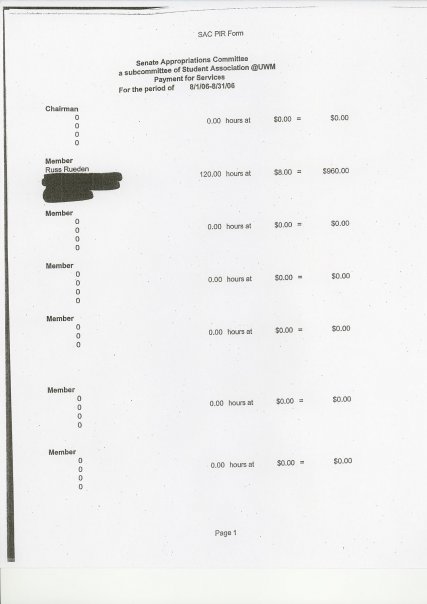
This is another document from the Student Association records. This one is amazing for two reasons. The first is that it represents the exact amount that appeared on Russ Rueden's time card for August 2006 (the one where he claimed to work ten days over the summer from midnight to noon). The second is the heading "Senate Appropriations Committee." The only association that the Speaker of the Senate has is to chair the meeting at which SAC elects its chair. So what is he doing being paid out of this account?

SA Constitution missing from website.

This may not mean anything, but the link that normally connects you from the SA website to the online version of the SA Constitution is not working right now. For those who wish to try it: http://www.uwm.edu/StudentOrg/sa/Constitution.htm

We'll see what comes of it

The Original Separation of Powers

Through my sources, I have obtained a copy of the original documents relating to the separation of powers. Note that Russ Rueden was arguing for the separation of powers at this time.

I did not get these from Ray Duncan himself, but rather from one of the people he chose to distribute this to initially.

These are copies of files that are on the hard drive, but do not exist in a
"document" form. It was very hard to get.

Please widely distribute.

Sincerely,
Raymond Duncan


UNIVERSITY STUDENT COURT
University of Wisconsin – Milwaukee


TEMPORARY RESTRAINING ORDER AND INJUNCTION


Acting under the authority granted in Section 4.3 of the University Student Court Bylaws, I hereby grant Speaker of the Senate, Clayton E. Clouse's request for a Temporary Restraining Order and Injunction.

This Order restrains all individuals in violation of the Court Order in Michals v. Clouse from functioning within the Student Association government. Individuals in violation must choose to serve on a single Branch of SA and to vacate their remaining office(s).

Individuals in violation of the Order in Michals v. Clouse that fail to choose by 4:30 PM on Sunday, September 12, 2004 to serve on a single Branch of SA are in violation of the Court Order thus illegally occupying their offices. At 4:30 PM on Sunday, September 12, 2004, members that have not complied with the Court Order in Michals v. Clouse will have all of their positions vacated, their titles in SA stripped of them, access to their office denied, and their pay suspended. In short, individuals that fail to comply will have all of their positions in SA vacated and all of their rights and privileges of those positions denied.


There will be a hearing on Monday, September 13, 2004 at 4:00 PM before a 2/3 majority of the Court to discuss the Continuance and/or Validity of this Order. The location of the meeting will be posted outside of Union Room 392 at least four hours before the hearing time.

On this 12th Day of September 2004,

It Is So Ordered.

________________________________________
Russell E. Rueden
Chief Justice


University Student Court
University of Wisconsin - Milwaukee

Senator Neal A. Michals, Student Association Senator and Shared Governance
Director,

v.

Speaker Clayton Clouse, Speaker of the Student Association Senate


Released Thursday, September 2, 2004.

Heard Before: Justices Rueden, Zahn-Craig, and Frank.


Introduction - Student's Self Governance

The Court acts as the guardian of the Constitution and the protector of all things just within the Student Body. The bylaws passed by the Student Association (SA) Senate and signed by our SA President grant us final authority in interpreting the governing documents that direct our student government. As the final student interpretive authority, it is important that we recognize the right of self governance. All matters heard before the Court have been dealt with exclusively by students, as demanded by Wisconsin State Statute 36.09(5), "The students of each institution or campus shall have the right to organize themselves in a manner they determine and to select their representatives to participate in institutional governance."

State law allows the students to form a government of their choosing. The students chose to create the Court and give us final interpretive authority: Section 3.2 of the Court bylaws: "The USC shall be the final source in all matters concerning the
interpretation of the Student Association's Constitution and its legislation."

The Court's decisions are therefore final in matters involving student governance. To stray from this destroys shared governance and ignores the will of the students that we are all here to represent.

Case Before the Court

This case began as the result of an election held during the Senate meeting on Sunday, June 6, 2004. The election was for the two Senate seats on Union Policy Board, a board that formulates policies for the UWM Union. Three individuals ran for two spots. Senator Robert Schuettpelz won with 12 votes. Senator Neal Michals and Senator Christopher Vega tied with 10 votes each. The (SA) Secretary, Ms. Scottie Allen, was not allowed to vote in this election as she was deemed an ex-officio member of the Senate by Speaker Clayton Clouse. The issue before the Court is whether or not Ms. Allen should have been allowed to vote, as she holds both the SA Secretary position and the position of Senator.

Issues in this Case

This case asks us to look at four particular areas of conflict.

The first area of conflict is whether or not an ex-officio member is allowed to vote. The current governing documents are silent as to whether they can or cannot vote. Therefore, in the absence of any guidelines, the governing documents tell us to look to Robert's Rules for clarification (Article II, Subsection A of the SA Senate Bylaws). It is clear in Robert's Rules that ex-officio members are allowed to vote (Article IX, Section 51 of Robert's Rules).

The second area of conflict is the question of holding dual roles within the Student Association. It is clear within the governing documents that the Student Association and the students at-large are looking to maintain a three branch government with a complete system of checks and balances. This is evident in the President's veto power (Article V, Section 5, Subsection C of the SA Constitution), the Senate's abilities to formulate legislation and over-ride a veto (Article IV, Section 8, Subsections D and F of the SA Constitution), the President's ability to appoint Court Justices with 2/3 consent of the Senate (Article V, Section 5, Subsection B of the SA Constitution), and so on.

The Student Association's attempts at forming "a more perfect student government (SA Constitution Preamble)," are being bastardized by the current administration in that many of the Directors are concurrently serving as Senators. This inevitably causes a great deal of conflict. The potential level of corruption in a government of this nature is immense. The student body entrusts that a three branch government will aggressively and proactively check each of the other branches. This is simply not possible within the current Student Association. The Chief of Staff, who also serves as a Senator, is charged with oversight of the Directors, many of whom are also Senators. It would be very difficult for a Senator to voice the wants of their constiuents when their supervisor is sitting next to them voting another way. The current state of the Student Association, in regards to the integration of the Executive and Legislative Branches, is completely unacceptable. The students elect a President to be their voice and to "promote our general welfare (SA Constitution Preamble)." To stand idly by and allow no true check to exist is deeply upsetting and will not be tolerated by this Court.

The third conflict that exists is the level of privacy between the three branches. It is very difficult for the Senate to conduct investigations of the Executive Branch when they share the same office space. This once again brings about the potential for corruption and destroys the ideal government that the students expect. The Vice-President is in a unique position in that he is both a member of the Executive Branch as well as the Legislative. It is therefore difficult for that office to be shared as he can participate in the activities of both branches.

The final conflict was the issue of how the tie was to be broken between Senators Vega and Michals in aformentioned election. Senator Michals argued that there should have been a run-off election. Speaker Clouse argued that Vice-President Rodriguez has all tie breaking authority. In reviewing Article IV, Section 6, Subsection A of the SA Constitution, it is clear that the Vice-President does have all tie breaking authority.

Orders

The Court is appalled at the current level of integration amongst the branches of government. We therefore Order that any member of the Senate that currently holds any office within the Executive Branch choose which of those two offices they would like to occupy and to vacate the remaining office. This must be done within seven calendar days of the release of this opinion. The Vice-President is an exception to this rule, as he is Constitutionally mandated to be a member of the Senate and technically does not hold dual roles. The Court Parliamentarian is also exempt as this is a Constituionally mandated service of the Court.

We further order that ex-officio members are currently allowed to vote. This however, would not change the outcome, as Ms. Scottie Allen was acting as the Secretary during the meeting and is not allowed to hold dual roles. As such, she should not have been voting at the meeting as a Senator.

We let stand the decision of Speaker Clouse to recognize Ms. Allen solely as the SA Secretary.

We further order that the Union Policy Board immediately address the office allocation and see to it that the Legislative Branch has their own locking office.

We finally order that tie-breaking authority in the Senate falls solely upon the Vice-President in all cases, as directed by the SA Constitution. Therefore, the
decision of Speaker Clouse to allow the Vice-President to break the tie stands.

It is so Ordered.

____________________________________________
Russ Rueden
Chief Justice


____________________________________________
Jessicka Zahn-Craig
Assistant Chief Justice


_____________________________________________
Ryan Frank
Clerk of Court


This is the temporary restraining order followed by the actual court case filed to deal with separation of powers.


Student Association
University of Wisconsin - Milwaukee

Office of the President
President Brett P. Belden

Response to University Student Court Mandates in the Opinion of Michals v Clouse

On Thursday, September 2 at approximately 5:20 PM Chief Justice of the University Student Court Rueden issued an email release of the opinion of Justices Rueden, Frank and Zahn-Craig which stated that I, as President of the Student Association, am responsible for enforcing the Court's opinion in the matter of Michals v Clouse. For this reason, I am issuing the following public response to the University Student Court's orders.

Background

First, I must address certain assumptions I am required to make in the interpretation of this court order. In reviewing the opinion of the Court, the only order I appear to have any direct impact on is the order of the Court for officers serving dual roles to choose one role within seven days of the release of the opinion and vacate the other role. Therefore, I will assume that this is the section of the opinion the Court states that I am responsible for enforcing and I will limit the scope of my response to this section. Furthermore, the Court has been unclear exactly how I am to address the issue of individuals who choose not to vacate one of their positions within the given time period. Again, the only power I myself would have to address this would be to remove the individuals from their Executive Branch positions, and thus I am forced to assume this is the intention of the Court's order.

With this being said, I would like to address the Court's contention that I have chosen "to stand idly by and allow no true check to exist." I have never disallowed checks and balances from existing in the Student Association as they are defined in the governing documents. In fact, I have never claimed that I am in favor of officers serving concurrently in more than one branch. The reality is, I do not have the power to impose a restriction on members of the Executive Staff that disallows them from serving on both the Legislative and Executive branches. Article VI, Section 1 of the Student Association Constitution states that "The Judicial Branch shall have a University Student Court, which shall have five justices. These Justices may not hold any other office in SA."

Clearly, the Legislature and students at large, in approving this Constitution, have defined this situation in which members of the Judicial Branch are restricted from holding offices in other branches. No such restriction exists in the Constitution for the Executive or Legislative branches; that is, no restriction has been approved by the Legislature and students at large to be included in the Constitution or any other governing document of the Student Association. Furthermore, precedent shows that Directors and other Executive Branch members have in the past served as Senators as well. Prior to the 2003-2004 session, Directors were actually placed under the Legislative Branch, and to my knowledge all of the Director positions were filled by Senators. With the bylaw changes that occurred at the beginning of the 2003-2004 session the Director positions were moved to the Executive Branch, but many Executive Staff members still served concurrently as Senators. Treasurer Ben Butz, Student
Organization Relations Director for the first semester Avigal Harris, Student Organization Relations Director for the second semester Robert Schuettpelz, who currently serves as a Senator, and Chief of Staff Clayton Clouse, who currently
serves as Speaker of the Senate, are all examples of individuals who served concurrently in both the Executive and Legislative branches in the previous
Student Association session. Considering these precedents and the fact that no Legislature-approved law exists prohibiting officers from serving dual roles, I
can only conclude that I do not have the power to disallow members of the Executive Staff from serving as Senators as well. To remove someone from their Executive position for serving concurrently as a Senator would make me vulnerable to very real legal action for unfair termination of employment, since I could site no rule currently in the governing documents as my reasoning.

Powers of the Judicial and Legislative Branches

Article IV, Section 8, Subsection (d) of the Student Association Constitution states that "The Senate shall formulate rules, regulations, and policies that govern the activities of SA." It goes on in Subsection (i) to state that "The Senate shall have the power to approve all SA By-Laws." This jurisdiction of the Court is in the interpretation of the governing documents of the Student Association. However, the effect of this opinion is to alter the governing documents of the Student Association, creating a rule where none exists in the Constitution. Clearly, Article IV, Section 8 of the Constitution reserves this power for the Legislative Branch, not the Judicial Branch. The Court uses the Preamble of the Constitution to impose its own opinion of what are appropriate checks and balances onto the Student Association. The Preamble reads, "We, the Students of the University of Wisconsin-Milwaukee, in order to form a more perfect Student Government; to ensure participation in Student Governance; and to promote our general welfare, do hereby establish this Constitution." In other words, in order to ensure a more perfect Student Government, we establish rules in the Constitution. Only the Legislative Branch has the authority granted in the Constitution to approve alterations to the rules and governing documents of the Student Association, and this ruling serves to take that power away from the Legislative Branch and give it to the three Justices who heard this case.
For me to take action against an officer serving dual roles citing only this Court opinion without the benefit of a legislature-approved rule change would again make me vulnerable to reprimand, not only on behalf of the affected officer, but also on behalf of the Senate for attempting to enforce a rule which the Senate did not approve.

Dual Roles in the Judicial Branch

I find it interesting that the Court is so appalled at the integration between branches considering its own Chief Justice is currently serving a potentially
disastrous dual role. Sandburg Halls Administrative Council (SHAC) is the second major governing body on campus. It is so important, in fact, that the 2003-2004 Student Association Senate passed a piece of legislation reaffirming its support of SHAC and acknowledging SHAC's authority in matters of residence life. This piece of legislation essentially reaffirmed SHAC as an extension of the Student Association in the shared governance process. The Chief Justice of the University Student Court currently is serving concurrently as the President, the head executive, of SHAC. The potential damage that could result from this dual role is certainly far worse than that of an individual serving in both the Executive Staff and Senate. What would happen should an individual who falls under the jurisdiction of SHAC be displeased with a decision made by the SHAC President and decide to turn to the University Student Court? Surely it would be difficult for that individual to find any sort of justice in the Court. Even if the Chief Justice were to recuse himself, the considerable influence he has as the head of the Judicial Branch would certainly affect the opinions of the Justices hearing the case.

Conclusion and Possible Remedy

In conclusion, the individuals affected by this opinion have been made aware of the Court's wishes, but I cannot personally take any action against the individuals who are serving in both the Executive and Legislative branches. I want to be absolutely clear that I am not purposely defying the Court, but rather I simply do not have the power to take any action without a specific clause prohibiting Executive Branch members from serving on other branches, as exists with the Judicial Branch. I leave it to the Senate to decide whether to pass a bylaw change implementing this restriction; I am most certainly not opposed to the discussion of a bylaw change, and I absolutely will do my best to enforce anything the Senate passes that is signed into law. I only ask that if the Senate considers the elimination of the dual roles that exist in the Student Association, it do so fairly and equitably, and address the dual roles which currently exist in all branches of the SA.


In service to the students of UWM,


Brett P. Belden
President
Student Association of the University of Wisconsin-Milwaukee


This is then SA President Brett Belden's response. Notice that he is aware of Rueden's cozy relationship with the Sandburg Halls Administrative Council, and notes how such a problem can exist even outside the normal divisions of student government.

Again, please widely distrubute these. I will offer more comment when I have a chance to study these further.

Tuesday, November 14, 2006

Annual Tradition -- Union Counting Day

Once again today, the fine tradition of counting the students who enter the Union takes place. As I mentioned last year, this is a rather tedious process that would be useful if it were accurate, but when you get a mass of people coming in from various directions, you can never be truly accurate.

Once again, I call for people to determine if we need this service. If we don't, perhaps we can use the money for real student services.